Film Preservation and Restoration - An Overview
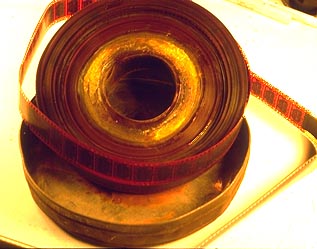
In picture you see a film, which is decomposing, close to it's last, final stage. Most of the reel cannot be unwound anymore; its images will be lost forever.
Simply and plainly, the activity of Film Archives all over the world consists in taking all the possible measures so that films can be saved. All sorts of films, the largest possible number of them. Films considered as classics, as important milestones of film history, or what we now consider mere examples of "commercial cinema", short comedies, documentaries, avant-garde works together with amateur films, down to the fragments, bits and pieces of works which lost their integrity forever but which somehow survive in the remnants they left - those fragments a Film Archive might find.
Often we are told that the 20th century- and even more the 21st - is to be considered the "century of images", for the powerful presence with which images of all sorts - mostly "moving images - entered the lives of billions of people, by telling fictional stories, by showing them the world, by luring them into propaganda or enlightening them with knowledge, by letting them record or recall facts and feelings of their private or social life, by entertaining them or by providing them new forms of Art, by…. Probably this is true, or maybe the role of cinema is overemphasized, in any case all of that simply does not exist if the films disappear, like the one in the picture above, if they cannot be saved to be watched again, to be judged again, to play again that role - whether big or small - they had in the past and they can have now and in the future.
And even if we disregard all of this as unimportant or just romantic, we cannot dismiss the point that films of the past do play a relevant role in shaping the images we experience every day, the images that are created now or that will be created in the future. And we cannot disregard the fact that these images have an increasing "economical" value, in a world where images - however transmitted or made available - have a fast growing role.
Under any perspective we see the problem, either from the historical, and cultural angle, of from the point of view of new creators of images, or "simply" caring for the economics of the moving images, we cannot but agree that to preserve, conserve and restore the film heritage is a task of major importance.
And this is the task Film Archives all over the world are struggling to fulfil. Either they are Film Archives in the strict sense, with mainly a cultural mission, or they are commercially driven archives (at TV channels, news, stock libraries, production companies, etc.), all contribute, in different ways and with different aims, to save the films, to make the cinema live.
In this context, Film Archives carry out all sorts of activities, ranging from collecting the films, to identification, cataloguing, programming, long term storage, and conservation… Among these activities, a central role is given to Film Preservation and Restoration. Because it is thanks of the techniques and the methods applied in this domain, that films are effectively and practically saved and taken back to the audience.
Films are often found in unique prints, or they are found in all sort of versions (dubbed, incomplete, censored, fragmentary, etc.) and they need to be copied so that new film elements are created, suitable for long term conservation and for projection, and the original materials, those unique prints can be stored and conserved for the future. And this is what commonly is called "Film Preservation", in other words the activity that makes possible to duplicate moving images and soundtracks so that they can be kept for the future and shown to new audiences.
Then, in the case of those films which are found in versions and in shapes which do not correspond to the characteristics they had when they were originally produced (in terms of content, or narrative structure or formal characteristics - photography, colour, sound, etc), the need comes for a more complicated, articulated activity, which is commonly referred to as "Film Restoration". By this term, we refer to those projects, which are designed in order to take the film back to its original form, by using all sorts of film or non-film materials. So we have to make use of all existing sources: prints, negatives, duplicates, in any form we find them, and of all existing historical documents (non-film) as scripts, screenplays, literary sources, censorship documents, production documents, reviews, advertising materials, etc. All of these materials will provide clues or evidences that will lead us to "restore" the film to the form is had when it was originally produced.
Both Film Preservation and Film Restoration are quite difficult activities, requiring a wide range of quite different knowledge, competences, expertises (from history of film technology to history, from film history to technical skills), which quite rarely can be summed up in one individual, that's why they necessarily require a high level of collaboration, which in turn requires knowledge and respect of the different areas of expertise, and full understanding of the different steps and phases of the process.
The information and the amount of data that you will find within FAOL (Film Archives On Line) were collected, produced and organised in order to make you knowledgeable on all of these aspects of Film Restoration and Preservation, so that your role in the laboratory or archive where you work or where you will work one day, might be more aware of the problems, of the limits, of the possibilities of these two newly born sciences or crafts.
We all hope you are interested, and we invite you to follow the steps into FAOL and into saving the film heritage….