 The Laboratory Work
Foreword
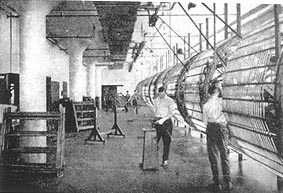
This is an image of a film laboratory in the Teens. Film technology has dramatically changed since then, but its basic principles are not. Printing, duplicating, grading, processing and cutting are all activities which are daily performed in laboratories all over the world, simply techniques, technologies and equipments have deeply changed, adapting to an increased search for quality and consistency.
Also when we are approaching film preservation and restoration, we are often dealing with techniques and equipment which are currently used all over the world for contemporary production. In a way, studying the problems of film preservation and restoration means to analyze contemporary film techniques at the highest specialization.
Archival materials need special treatments, special attention and special procedures in order to bring them back to the original qualities they had and which are lost or endangered by the passing of time and sometimes by men's carelessness.
|
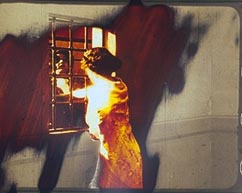
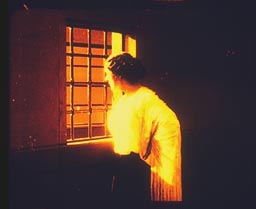
A silent film before and after restoration |
Central aspect of film preservation and restoration is duplication, which is, the process by which we copy picture (and - in a loose sense - sound) onto a new material in order to make a long term conservation of the film possible, or to bring it back to the audience. This "plain" definition hides an endless list of problems, a list as long as the hundred years of cinema and as complicated as the dozens of film gauges, film processes and film stocks used in this century of cinema. Also, duplication have to face the limitations of contemporary technology (as equipments or film stocks) to deal with archival materials which are obsolete since decades.
From these few notes, you can see how duplication is central to the laboratory work involved in film preservation and restoration, but we must not underestimate the importance of all of the other steps and phases of the process. Each phase plays an important role, and only by keeping the highest possible standards in each of the phases we can expect a restoration to be really effective and successful. It is also important to fully understand the level of interaction of the different phases of the work. It is in facts important not only to provide high standards of quality in each separated phase, but also to make sure that the level of interaction among the different phases and department of the laboratory is optimized. If this is not the case,we cannot guarantee true high standards and we cannot produce consistent and correct results in the restoration process.
For all of these reasons, it is important to know the different phases of the laboratory work, even when they do not seem to be related to the activity we want to master. So, before you start your in-depth reading of the section (or sections) that are mostly interesting for you, we strongly suggest that you take an overall view of all of the steps and phases of the work.
The following links will take you into the different phases of the work and - ideally - into the different "rooms" of a film preservation and restoration laboratory. Now, open the door and enter the laboratory….