Projection
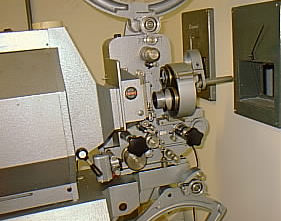 Projector
technology has changed little since 1910, but light sources have.
Projector
technology has changed little since 1910, but light sources have.
Film made prior to about 1950 would have been seen by carbon arc, after that increasingly by xenon arc.
16mm was generally projected by incandescent tungsten until the mid 1960’s and then increasingly by tungsten-halogen.
Modern projectors are brighter - the standard brightness of a screen image today is 9-14 foot lamberts but most modern cinema and surely all laboratory screens are generally brighter than 18 foot lamberts
The best projection system for assessing quality of a restoration is a cinema projector producing the standard light output required of a commercial theatre since that is where a film will be seen today.
Sometimes it is also advisable to be able to perform a double projection, so that we can see the original film and the newly restored print side by side. In this case it is highly advisable that the projector used for the original print has the characteristics (of light, steadiness, lenses) that they used to have at the time of production or distribution of the original film. The same, of course, applies to sound checking and sound equipments.
It is also to be noticed that there are several sources for standard condition of projection, for both commercial theatres and for laboratory checking rooms. These standards are to be checked and to be applied; otherwise it is impossible to judge a result on the screen in an objective way.