Handling the can
First Step: Opening the can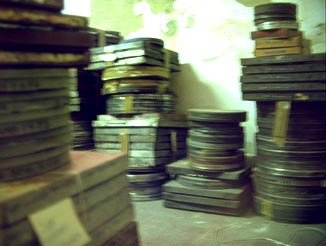
The opening of the can is an operation that doesn't usually give any problems. If, however, the can has just arrived in an archive and has to be opened for the first time, it's necessary to follow a precise working method that will permit, in the subsequent phases, a proper carrying out of the restoration intervention.
How to do it
Often rusty and deformed cans arrive in the archives that are very difficult to open. You should consider that you could find yourself handling a can that no-one has opened for decades and that has been exposed to strong variations in temperature and humidity.
You can use the following methods for examining the film. They are in order of increasing forcefulness and severity:
a) Hold the can horizontally, with a hand on each side and the lid uppermost, and tap the edge of the lid downward on the edge of a shelf or edge of a bench or metal rack.
b) Hold the can horizontally, supported between the left arm and the hip, with the lid on the underside. Strike the edge of the lid smartly with the edge of the right hand, adjacent to the little finger. Repeat around the edge of the lid. This sounds as if it should be painful to the hand, but, in practice, it need not be so. This should release the lid. Take care to prevent the lid from falling off completely and the film falling out. This has been called the "karate chop" method.
c) Place the can upright on the floor; place a foot gently on the top of the upper edge of the can and, pressing with the foot, roll the can back and forth a little way.
d) Using a wide-bladed screwdriver, insert the blade between the lip of the lid and the little shoulder which is usually found on the edge of the can and twist. Repeat around the edge of the can. Beware of forcing the screwdriver under the lip of the lid and levering up. This is bound to bend the can, which may not matter in itself, but is also liable to cause damage to the film within the can.
Recording the information found on the inside and the outside of the can.
If you have been the first one in the archive to open the can, you must carefully record all the information in and on it before proceeding to take the film out and put it in a new container.
In fact, it is quite possible that the film you are about to examine is a fragment without credits or other information that would make it easily identifiable. Thus, the loss of the information on the can could cause serious problems and substantial loss of time. So, examine the can carefully and record the following information.
- The form and material from which the can is made
In fact, this simple external analysis can give information as to the date of the find. For example, in the second decade of this century it was common for the major production houses to paint the can and design their trademark on it or stamp their trademark on it in relief, and also if cardboard or metal was used.
- Any writing that might be present
Normally there is always a label glued onto the can that carries the name of the film. Record the title and don't make any changes in what might seem to be incorrect spelling. Note and record the presence or absence of anything stamped onto the label. If the can has not been manipulated, the label should indicate either the producer or the distributor. Often all this information is difficult to record due to the fact that when paper is exposed to dust, humidity, rust and tearing it tends to decompose and therefore render indecipherable any writing.
- Any labels, papers or cards that might be inside
It is possible that inside the can there are pieces of paper.
These can have five different origins:
- Official information, especially the censor's permission, which in many countries had to accompany the film,
- - Technical directions from the producer, especially if it is material in the form negatives or preceding the final positive copy,
- - Information from the printing laboratory, e.g. light sheets
- - Information from the distributor with advice for the projectionist or regarding the conditions of the film
- - Technical or theoretical
information about the film. All the information found should be compared
and will be useful in
identifying the film and reconstructing the history of the find. Of course, the viewing of the film will be decisive, but a correct recording of this information will result in an enormous simplification of the subsequent work.
Second Step: Putting the film in a new can
In order to proceed with putting the film in a new container, necessary for a better conservation, it must be first removed from the old can, being very careful not to create any further damage. The method that we have found to be most successful is this: the can should be tipped onto its side or edge and the film removed whilst it is still in an upright position. (The reason for this is that if the film happens to be loosely wound and an attempt was to be made to remove it whilst it was lying flat - then there is a strong possibility that the centre could fall out. If the can is tipped on its side, then the bottom of the can steadies the film.) Then put the third finger into the hole in the middle of the reel and the thumb on the outside of the reel and lift it out.
Which can? Steel or Plastic?
This operation is extremely delicately and should be performed very carefully. Be especially careful not to allow the central part of the reel to fall, as it often tends to separate from the rest of the reel Now the film may be put into a new can. You should know that today there are two types of containers utilised in the cinematographic industry:
Steel cans
Iron cans are utilised by most distributors and archives as they can be obtained at an especially low price. The disadvantage is that they can become rusty and deformed, allowing dust to enter and risking the destruction of entire coils of perforations.
Plastic cans
Plastic cans are now being used in some archives. Users should beware of cans made from chlorine plastics, since the chlorine may separate and have an adverse affect on film. Polyethylene is the most usual material and is considered sufficiently inert to minimise the risks referred to above.
Plastic cans have the property, valuable in some climates, of being immune to rust. Note that cans of other metals such as aluminium alloys, or galvanised iron, are subject to corrosion, which can create dust in the can. It is probably wise not to stack plastic cans too high. Left under great weight for long periods, the bottom cans of the pile could become distorted and the weight of the pile descending upon the films themselves.