Splices
In the silent era, the various sequences of most films were spliced in the
positive copy, quite different from modern film production methods and the
number of splices was enormous. The problem of print splices largely
disappeared with the advent of sound, for which the laboratories preferred to
print positive copies without splices, or at least around
1930. Several other new laboratory techniques arrived at about the same time
and it is difficult to interpret precisely why the changeover from
"positive cutting" to negative cutting occurred at just this time.
Newsreels and some magazine programmes [like British Pathé's Eve's Film Review]
used negative cutting from the early 1920's.
Cement Splices
All early types of splice used acetone or solvent mixtures to dissolve the film base and fuse two superimposed pieces.
Film joins were generally, but not universally at the frame line area. There are many different overlap positions and widths, some extremely narrow but the earliest covering up to a third of the picture area. The emulsion in the cemented area was always scraped off to allow the two bases to fuse but the efficiency of scraping varies and some early joins are very thick - others are much thinner when a lot of the base has been scraped away to reduce the join thickness to close to that of the rest of the film. Early film base was not made to a standard thickness; only later did it become more or less universal to use a 5 mil [a US measurement equal to 5 thousandths of an inch, 1 mil equals 0.025 mm] base for 35 mm and 7 mil for 16 mm.
Old types
Over time the cement join tends to weaken and the splices may become undone. The splice is said to "dry", but the exact mechanism that causes a fused join to break is not clear. Some splices were made with a cement of just a solution of film base in acetone, but several successful chemical additives were used by the 1940's that considerably improved the life of nitrate joins. Joins made in the 30's were more likely to "dry" than those later because these additives were not available rather than their age. The Kodak Film Cement of this period was the first to use dioxane (dioxin) as an additive. For a number of safety reasons conventionally available modern film cement no longer uses these additives.
If the film broke during projection, then the projector operator would repair it with an acetone cement splice. Splices that are found in prints within a scene or are found in the long rolls of print from after 1930 are almost certainly projector breaks. In this case, in order to rejoin the film at least one frame was taken out [often much more] to make the join.
Current types
There are a number of different cement join techniques and splice sizes used today.
- -The "negative" join is used for negative to be printed, is narrower than a positive join, and different joiners are available for these. Some of the best joins were made on equipment that uses heavy pressure to hold the film for the few seconds as the cement hardens. One of the best splicing machines ever made was a foot pedal operated splicer with a heated pressure plate from Bell and Howell and was made for some forty years. Today almost all joiners are portable small units.
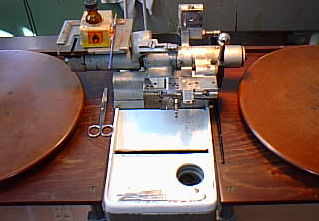
|
A picture of the Bell and Howell foot pedal operated splicer |
2. The Hamman join is a very narrow overlap that fits within the space between the frames of modern 35 mm film. The cut and overlap is diagonal and entirely within the thickness of the base, so that no scraping is required. The Hamman join is very strong for it's overlap but is not used for print films. It is probably the most widely used join today for modern cut negatives as it has no "step" at the junction and thus splices create no obstruction to the printer gate or drive resulting in a steadier picture. The cutter is a separate device from the clamp that holds the film in contact while the cement dries. This join is not recommended for nitrate film.
Cement types for archive materials & Formulae
Fusion joins
Cement joins are used in modern film production for cut negatives but a number of other join methods have replaced cement for most other purposes. Fusion or welding [using heat or ultrasonic can be used for some film bases especially polyester [like Mylar and Estar] and tape has replaced all temporary and many other joins. A very effective polyester join uses a tape that is bonded to the base by heat.
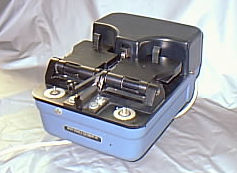
|
A Metric Splicer Ultrasonic splicer for polyester-base film materials |
Tape joins
In the 1940's, Leo Catozzo, in Italy, devised the first splicer that used adhesive tape instead of acetone and that punched out the perforations from the tape after the join was made. The idea was not taken up extensively until about 1965 when clear self adhesive tape became more common generally. The film is not overlapped. Instead, the two cut ends at the centre of a frameline are butted together and taped across on both sides. This invention greatly simplified the work of film laboratory and cinema operators, but creates a serious problem for conservation. The tape tends to lose its glue, which after some time, softens and oozes out from the splice and sticks to the subsequent coils of film on the reel. Fortunately, this problem is limited to positive copies, since negatives aren't normally spliced with tape.
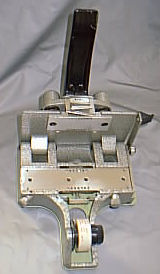
|
On the left: A CIR 35mm tape splicer. |
Also fortunately, although the effects of softened adhesive is messy it does not seem to have damaged images and it can be cleaned off by hand with almost any of the cleaning solvents such as 1:1:1Trichloroethane or Perchlorethylene.
Air bubbles trapped between the tape and negative film show on printing as dark ovals or rings.
There are many tape splicers on the market now and a number of different tapes and glues. Some are quite disastrous and soften at quite low temperatures. Others discolour in time to a pleasant [!] yellow. Some will put up with being wet [for example in a processing machine] and some just fall apart when wet. Recently, that is in the last ten years, tape joins have become far more widely used for television news splicing and for some telecine work. It is much easier, and requires less training, to make a safe tape join than a cement join. The only tape recommended for this work is made by 3M and slit and marketed by a number of specialist motion picture supplies companies.
In some cases, it might be preferable to use adhesive tape rather than cement to make a splice. There are two overriding benefits in using adhesive tape.
- It allows the technician to avoid cutting a frame out provided here are two whole frames to splice even if there is no overlap, as all tape joins are butted together and not overlapped. In almost every case, a new cement join will result in the loss of a frame.
- The splice and the tape can be removed without damage or risk to the adjacent frames.
Professional Super 8 and Standard 8 are occasionally seen to be cement joins but all amateur Super 8 and most Standard 8 joins are tape joins since the first release of these formats in the 1960's; 9.5 mm was originally cement joined but tape joins became available at the same time as Standard 8.
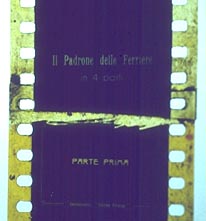 Repairing old splices
Old splices need to be checked before printing in order to be certain that they will not break on the printer. Telecine machines with capstan drive are less critical, but so much damage can be done to film by a break on a machine that any doubtful splices must be redone. An old join can be tested by a twisting action of the film; if it parts or starts to part, it would have been unsafe on a printer. Sometimes every splice must be remade! Generally an old insecure splice can be peeled apart, the overlaps re-scraped and re-cemented.
Cement
Some archives replace a cement join or reinforce it by placing a tape join over the top on one or both sides. This is actually very effective, and rarely can an experienced technician see that this has been done on the reproduction if 8-perforation tape is used. This tape overlaps two 35mm frames and the edges of the tape are over the frame lines either side of the splice. The archive must be aware this has been done, as it will probably be necessary to remove the tape before returning the film to the vaults.
Films from the silent era did not have a common standard as to the position of the frameline. Today the standard frameline position falls exactly midway between a pair of perforations. On early nitrate prints, the splice usually falls within the picture and not on the frameline. Usually this does not prevent a splice from being re-cemented in the same position.
Equipments
The pins of the modern splicing machine may be too big for the perforations of a nitrate film due to shrinkage reducing the size of the perforations. You will also find that the pins are too far apart, for the same reason.
Most splicing machines for cement splices can be altered to handle short pitch, shrunken film simply by replacing the pin plate designed for short pitch. However most machines used for this purpose are so old that their pins are worn and accept a range of sprocket hole positions, and normal film is capable of movement on the pins rather than being held precisely. Alternatively, new pins can be filed down on the edges of the teeth that face the join position. This last solution carried out carefully and empirically seems to be as good as specially made short pitch pin plates. In principle, a range of joiners to handle the range of shrinkages is required. In practice, the unsteadiness produced by these errors is insignificant beside the unsteadiness native to early films.
By hand
In some rare cases, it is necessary to make repairs by hand, without the help of a splicing machine. The pitch between the perforations must remain constant different ways. One end of the film to be joined is cut along the frameline. The other will have the entire frame plus an overlap (about half the distance between one perforation and the other). In order to achieve this it is necessary to sacrifice one or other of the two end frames in order to make the splice.
The cement that is used for safety film (cellulose triacetate and diacetate) does not work as well with cellulose nitrate material since the dissolved polymer in the acetone is triacetate, but an additive to the standard modern film cement [a small percentage of cellulose nitrate] will make effective nitrate cement out of commercially available triacetate cement.