Analyzers.
All grading was done by sight until about 1960, and early colour printing was therefore by trial and error. A test print was made, sometimes using just a few frames of each scene, and the result used as a guide to making the corrected print. The first colour negative-positive process was Agfacolor in 1936. The negative was unmasked but the grading must have been exceptionally difficult, and almost entirely based on trial and error. It is widely thought that this was the most difficult of all processes to grade because there was no analyser. Between 1920 and 1950 there were many colour systems that required grading during the printing stage, and the additive Dufay negative and the various two colour duplitized films as well as the early Technicolor processes, in which three layers of colour were cemented together must have been far worse.
The first video aid to grading was the Hazeltine Analyser (Photo and Diagrams), produced by a company specialising in aids for the graphic arts industry and as a "spin-off" from a graphic arts colour analyser about 1960. This was a reverse phase scanner that displayed a video image of the negative as a positive and allowed the operator to alter the visual balance and brightness with controls linked mechanically to a display of the subtractive filtration needed to print that negative. The Hazeltine revolutionised colour printing in the USA and Europe, but some of the major world feature film countries such as India and Egypt continued to use trial and error for another 15 years. In 1966, the Hazeltine was adapted to provide data for the additive lamp house from Bell and Howell, and later Peterson, Hollywood Film Co., and Debrie. The Hazeltine has been upgraded since it’s original inception, but it is still a unique device using fairly non-standard components and principles, and many Hazeltine in the world are now well past their best and the video images they produce are often only a little better than trial and error..(Explain)
By 1965 it had been joined by the Kodak Video Analyser, a scanner with a TV display based on the field sequential display system of spinning red, green and blue filters in front of a monochrome tube supplied with R G B signals in sequence with the filters. The picture was small [only about 200 mm wide] and the machine noisy, but these two analysers became the workhorses of the industry for twenty years. Today, the original Kodak VCA is still used in some laboratories.
From the early 1980’s, a number of other analysers joined the industry and today there is a choice from Hazeltine, Filmlab, Debrie and others, but the dream of using a telecine unit such as a Rank Cintel adapted as an analyser has never materialised and this has proved to be a major weak link in the film system.
|
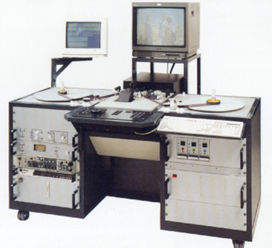
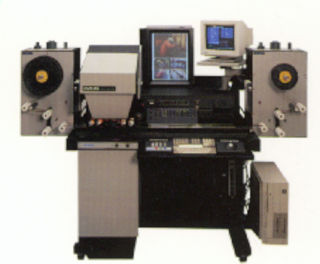
Two different, recent models of Video Colour Analysers. Apart from differences in design, they have similar features and characteristics. Both have two monitors, one for the film image, the other for the FCC and light change computerized system, and keyboards have a similar layout. Note that the film in one model film travels horizontally while in the other, vertically. |