Light change and cueing systems.
It was standard practice in laboratories to pre-notch negatives particularly feature films. Every scene in the film would be notched before the film passed to the grader, usually where there was a cut-in dissolve a notch would be put at the start of the optical and another one at the mid point of the dissolve. Pre-notching a film speeded up the work of the grader and allowed him to get on with the grading and not have to notch the scenes as he went along. It did mean that sometimes you could have many unnecessary light changes.
Debrie introduced a frame count type of system. It is some times known as a long chart.
The film was graded on a special Debrie synchroniser table with a roll of cardboard or parchment film, that ran through the synchroniser at 1/8 the speed of the negative. Every time the grader wanted a light change, he used a punch to cut a small rectangular hole in the chart. When the negative was printed, the chart ran through a head on the printer that had feelers to detect the holes and operate the light change. The system had the advantage that there were no notches in the negative but had the disadvantage that the table was required for grading or re-grading so making a correction quite time consuming.
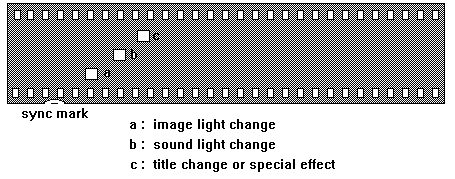
Notcher and Vinten Grading M/C
Vinten used a similar system that had a 70 mm wide parchment roll with holes punched in it to record the value of the light change. The chart roll was cut on a special grading machine that had a wheel with 21 cut outs. In each of the cut out was a single frame of negative that printed at that light. The grader compared each scene with the sample frames and matched it to the one that looked most similar. That gave the grading light that was then cut into the chart. The chart moved at 1/100th the speed of the roll of negative.
Vinten in some of their machines in America used a metal staple to make the light changes. It was a single staple but apparently suffered from the fault that the printing machine sometimes missed a staple and then the rest of the roll would have wrong lights.
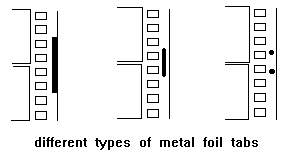
The next system to be introduced was the RFQ. The RFQ
stands for Radio Frequency Cue because the electronics used radio frequencies.
This was a small adhesive aluminium tab stuck on the film when a change was
required. The printing machine was equipped with a metal detector probe that
detected the tab as it passed close to the probe. This system has the advantage
that it does not damage the film but has the disadvantage that cleaning
machines can cause the cues to come unstuck from the film
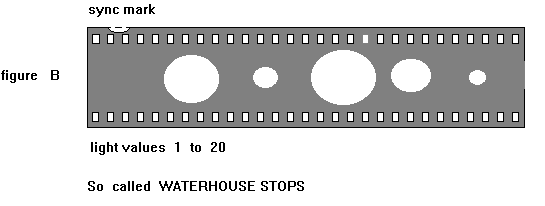
Debrie and Union used a piece of black opaque cardboard the same size and perforated as 35 mm film with holes cut into it according to how much light was needed. Opaque film can also be used.
Lynes used a bank of resistances selected by micro switches to vary the brightness of the lamps. Vinten printers used electro-magnets and mercury switches to vary the resistance to the lamp. Lawley printers also used resistances.
Probably the greatest improvement was the light valve introduced by B&H on their Model C. This is an electro-mechanical device. Wedges are used to open and close a pair of vanes that produce a slit to alter the amount of light. The advantage of the light valve is that it can be fully automatic and can operate very quickly so that the printing machine can run faster. The Model D ran at 60 fpm while the Model C ran at 180 fpm. The light valve became the universal standard for all printing machines. More recently electronic light valves have appeared which operate even faster and machines can run over 1000 fpm.
We can now get to the method of passing the "How much light" to the printing machine. We have already mentioned that the B&H D and J printers used a hand written card using numbers between 1 and 22 and that the Debrie and Union used a chart with circular holes of varying sizes cut into it. These went from 1 to 20. Illustration LYNES CHART Union, B J Lynes and Debrie also had a system using cardboard film. The value of the light change was determined by the position of a pair of rectangular holes. The five positions in the first row had the values of 1,5,9,13,17 and the four positions in the second row had the values of 0,1,2,3 so that two holes can give us all the values between 1 and 20. Vinten printers used a cardboard chart but 70 mm in width. The Lawley as we have already mentioned used the staples to give the light value. These went from 11 to 1. With 1 giving the most light unlike all the other systems where 1 was the lowest light.

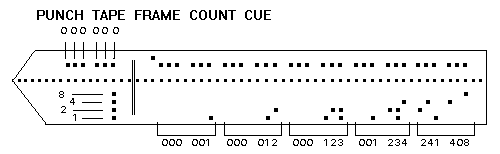
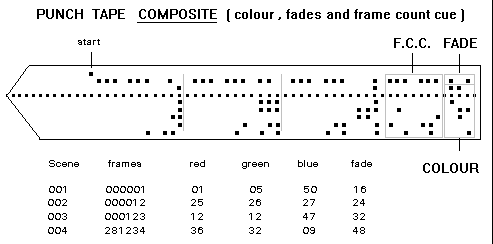
The B&H Model C uses a computer paper tape with eight rows of holes and a row of tractor feed holes. The first six holes have values of 1,2,4,8,16 and 20. The other two holes are used for start and stop information and information for automatic fades. Each light value is recorded as a set of three rows of holes because the Model C is designed for additive colour printing so the Red Green and Blue light information is required for each cue. When printing B/W each row has the same numbers. It is worth noting that although it is normal for the values to be R G B some labs use B G R.
Computer technology is used for the latest generation of printers.
The difficulty for an archive grader working in a laboratory where some or all of these machines are in use is that all the systems have different increments between light values. For example the Model D has an increment of 10%, so the each successive light gives 10% more exposure than the previous light. The Model C has an increment of 0.25 Log Exposure that means the amount of light doubles every 12 points. The Debrie system has an increment of 6th Root of 2, meaning the light doubled every six lights. The Lynes reduction printer has each resistance value adjustable so you could match it to any other printer.
Graders usually have conversion tables between different printers although the best graders can grade for the appropriate machine so that if they were grading for the Model C they would think 1 to 50 and if they are grading for the D then 1 to 22 or 1 to 20 for the Debrie. It is only a matter of practice but it is much quicker than grading for one system and then converting.
For Other Information on Light Changes and Cueing Systems, check Printing Section