Exposure control.
In order to obtain the best possible result in printing, whether we are producing a release print or a duplicate; sensitometric instructions, and therefore exposure corrections, must be carefully followed.
The Printing machine must be able to perform light change exactly when they are required, with a precision that can vary from one to 4 perforations (in case of step printers or continuous printers). So it is responsibility of the operator to check if the machine is performing correctly, and that the information is provided correctly to the machine, in whatever form (diskette, punched tapes, etc.) is needed, and that loading of the machine is correct.
Different machines have different cueing systems (the system by which the machine is instructed where to perform a light change) and different systems to modulate exposure; and the operator must know these systems and how to verify that they perform correctly.
In addition, the operator must carefully set up the machines with all those procedures and manipulations (setting trimmers, checking lamp voltage, inserting filters, etc) that are required.
Any mistake in these settings and procedures inevitably has the effect that the whole work - one or several reels of exposed materials- are not usable and cannot be processed. Usually this implies a loss of time and material, but in some case it can represent a total loss, whenever, for example, an original material is in such conditions that cannot run through the printing equipment twice.
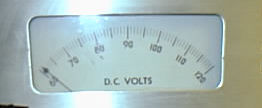
|
A Voltmeter on a printer: lamp voltage is one of the several parameters to be carefully checked before printing |