CROSS MODULATION TESTS
Cross modulation tests are essential to keep control of the quality of the sound during these processes and to avoid distortions.
For high quality recording and reproduction, the print must have the highest possible density to give a high ratio signal to noise, a high level (difference between opacity and transparency), and a low distortion.
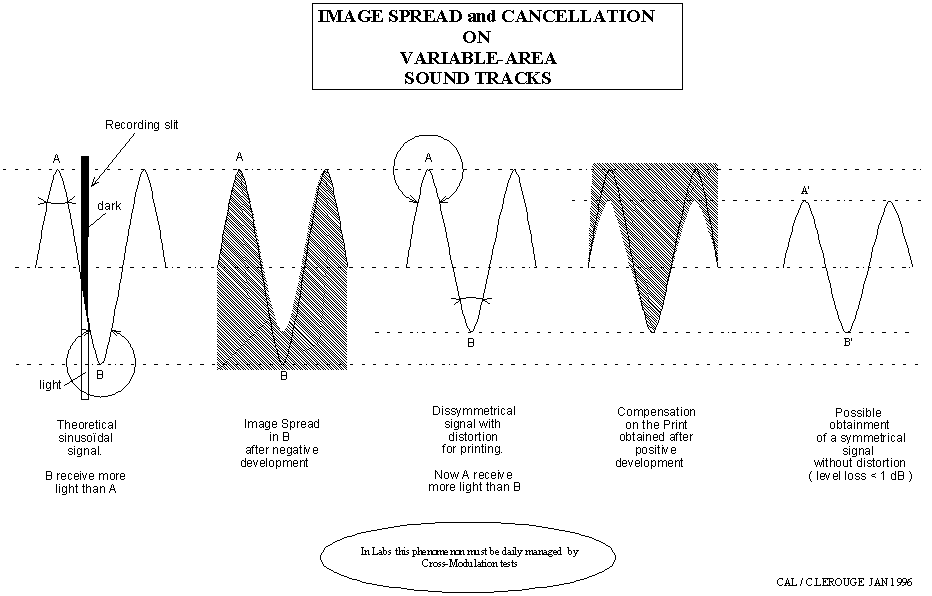
For a variable-area recording, the print density should be approximately 1.5 for satisfactory reproduction (this number is given by stock manufacturers). Under this density, after development of the positive, image spread appears that fills the valleys of modulation and keeps the peaks of modulation sharp. This non-symmetry is caused by the high density that is required. It produces an incorrect, distorted signal. It is necessary to have image spread in the negative to compensate the image spread in the print (which is in the opposite direction).
The Cross-modulation test is used with variable-area recording to determine the correct negative density by measuring the fill-in of the valleys in modulations.
A similar test was used with variable-density recording for determining negative density, but it was named "Intermodulation test".
On the illustration below, you can see the recording slit.
In A there is less light than around the point B. This quantity of light produces a latent image in the grains outside the exposure area. When developed at low density the filling is reduced, and it is increased under higher densities.
On the developed negative, a distorted signal is finally obtained. Fortunately, when this negative is printed on positive film, around the point A, there is a great amount of light, while a lot less at B.
This gives compensation, after positive development, as determined by the Cross-modulation test.
Finally, a good symmetrical signal without distortion, is obtained.