Grading.
In the previous sections, we have been through several steps of the work of film preservation. These steps correspond to the path followed by a can of a film element arriving in an archive. Recording information on and inside the can, checking the state of physical preservation of the reel of film, identifying the element and comparing the information with that collected previously in the archive. Then, according to the existing elements, deciding to reconstruct the text of the film, and finally proceeding to the necessary repairs and treatments of all the different elements of the reconstructed film, and preparing them for printing. The last step, before printing, is grading.
In the previous sections, information has been given to you about the basic network of duplication, the contrast rule, black and white negative and reversal process, film bases, characteristics of existing negatives for printing and the reproduction of colour. All this data are useful for the understanding of the work of grading.
The Principles Of Grading
The grader, called the "timer" in the USA, is the technician responsible for defining the printing conditions of a negative [or any other element to be printed] and is thus responsible for the general picture quality achieved by the laboratory from that element. Grading is the process of estimating the printer cues and printer lights needed for each scene. There are a number of devices available, based on video displays of the element in a positive form and known as Analysers or Video Analysers. They simulate the appearance of a print under printing conditions, by scanning the negative. Some black and white grading is still carried out by graders who view the original negative or element and assess the printing conditions by experience. This is known as Sight Grading.
Grading, especially sight grading, sometimes results in a proportion of scenes that are incorrect at the first print, requiring correction at a second printing, depending, of course, on the skill of the grader. Equally, sometimes the grader will assess a scene differently from the client; whether he is an archivist or a commercial customer, also needing a second try. This is true for all work whether archive or not, and a set of terms and a production procedure has grown up over the last 100 years of film laboratory work that is also reflected in the methods commercial laboratories use to charge their customers for the work done. The first graded print made of any element is known as the Answer Print. This is shown to the client - it may contain minor grader’s errors of judgement but generally is what the grader considers a good first print. Once the client has seen it and commented, a second print, called the Show Print, is made with the corrections. A good grader is one that needs few changes between these two. A client is charged for both these prints on a price per length basis.
Once a print is past the Show print stage, it usually waits until the distribution procedure is planned. If a number of prints are to be made, the laboratory usually advises on whether one or more duplicate negative is needed, in which case this is made and a print made from the duplicate called [in some labs] a Check Print, sometimes called a Control Print. All the Release Prints are made on this grading basis. This broad procedure has existed since the 1930’s and applied to colour and black and white whether negative-positive or reversal-reversal systems are involved. Technicolor imbibition printing used different terms and sequences. Archives that use commercial laboratories generally have a different arrangement due to the fact that, in general a print, or old grading data, already exists that can indicate the original grading. In addition, archives want to reduce the cost of prints, so the two print system is often replaced by a single print.
This works well in the majority of cases but inevitably there are instances when a second print with grading changes is needed. "Re-grading" or "grading corrections", to make this second print, or correct an Answer Print, are usually carried out by the grader by sight. The image is viewed in a theatre, on an editing table, or over a light box, at a "regrade station", a location with a keyboard [or just a pad of paper!] that allows the grader to modify the original printing conditions and create a corrected printing programme.
All modern colour printer’s printing lights and cues are driven by software, and increasingly the cueing and printing light data from the analyser is being stored on a hard disc and provided to the printer via a computer network. The additive lamp-houses originally designed in the 1960’s and upgraded by electronic light valves are the basis of all software-controlled printers. In archive work many elderly printers are still in use either because they are able to handle shrunken film or because archive laboratories find it difficult to afford or justify modern equipment, and these are rarely controlled by computer software unless they have been fitted with a relatively modern light valve lamp house compatible with software control. The Debrie Matipo printer, for example, can easily be fitted with a modern additive lamp-house. However, even quite sophisticated specialist laboratories that already have modern additive lamp-house printers for their modern production, retain old printers for special purposes, and these often retain their original light control mechanisms. Grading using these old systems often has to be by sight, or by trial and error.
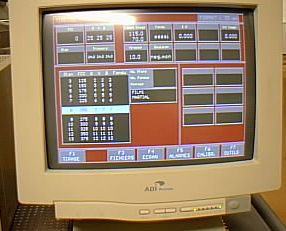
|
A modern printer's monitor. Note that all parameters are controlled via software. |
The Perception of Images
The grader needs to be aware of some of the characteristics of human vision, especially as they relate to viewing a projected image in a darkened room, a cinema.
The human eye is sensitive to brightness via the rods of the retina, which cannot separate colour, and this sensitivity is at it’s greatest for wavelengths around the green Illustration, peaking at about 550 nm. The cones of the human retina are assumed to exist as three different sensitivities, each sensitive, and able to separate approximate thirds of the visible spectrum, Red, Green and Blue, and the sensitivities to wavelength overlap. Thus, any colour is seen as a combination of red green and blue signals, and brightness is primarily influenced by the rods, which cannot separate colours.
The process known as "general adaptation" enables the iris of the eye to open or close to establish consistent perceived image brightness even if the projector brightness varies. In practice, if the screen illumination is between 8 and 14 foot-lamberts (explain) the brightness appears to be similar and so these values have become standard aim screen illuminations although today screens are often brighter than this.
The colours of any image will be dependant on the dyes present but also on the light source of the projector or viewer. Light sources are usually measured in degrees Kelvin or Colour Temperature - the higher the colour temperature the greater the blue component and the less red light component. Therefore the grader’s judgement will be influenced by the projector light source, and theoretically, a print will only be correct for a specific light source.
Several different light sources were used in the early days of the cinema, with open carbon arcs for 35 mm being the most frequent, and some use of incandescent [tungsten] lamps especially for 16mm or smaller gauges. By 1965, the improved carbon arcs were being replaced by enclosed xenon arcs (or lamps), and these are almost universal today. Diagrams
The human eye is surprisingly adaptable and over a wide range of screen colour temperature, or colour, adaptation occurs, whereby the "over stimulated" cones tire and after a few minutes of viewing in a darkened room with no permanent visual reference, the image perceived tends to become neutral regardless of the projection light source. The image colour balance needs to be within certain limits for an apparent "neutral" or "balanced" image to be seen but the effect occurs with both black and white and colour images. Pale tinted film quickly appears to lose the coloured effect.
The black and white images of the past have been quite variable in colour
and were certainly not uniformly neutral even when not tinted or toned. The
image colour of silver images depends on the developing agent used in the
process, the presence of some other components in the process and the original
manufacture of the film stock. The earliest developing agents produced images
that included developing agent oxidation products, which were not neutral, and
many early images were brown, sepia, and even slightly greenish!
However, after a few minutes viewing they all appear to be the same. The
monochrome tinted prints also visually "fade" in effect and some of
the very pale tints quickly lost their effect although what was seen was the
cut from one colour to another, before the next period of adaptation began.
Strong colours are not adapted to and are seen all the time Interestingly toned
prints do not lose their visual effect so easily, probably because image was in
tones from white to colour, and double effects, such as iron tone blue with a
pink tint can always be seen without any adaptation by the eye at all.
Colour film perception
Adaptation to colour is an important aspect of colour grading, and the grader’s job is to locate a colour balance that is acceptable and "neutral" to the client or the viewer, and retain that balance from scene to scene. Changes in relative balance from scene to scene are often more disturbing than the overall aim. Television changed some of the "rules" of grading as the TV screen is usually viewed in lit surroundings. TV grading standards are usually considered more stringent than those for the cinema. The European standard for viewing sets a TV colour temperature of 6500K, Illuminant D, as being close to the standard TV tube but also close to daylight. In practice there is rarely any argument over whether an image is "correct" or not, and grading is a precise operation although there is much that is not fully understood. A colour grader must have good colour vision, and this can be tested using the simple Tests for Colour Blindness by S. Ishihara [or the more complex 100-Hue test]. About one in five men have some departure from good colour vision and about one in eight or ten women, and some countries use women graders exclusively because this is realised, and because it is felt that women make better, more confident, colour graders in particular. For some reason this is not so throughout almost the entire English speaking world, where graders [and telecine operators] are almost universally men.
